
What We Owe the World We Love
There are artists whose deaths make us mourn the books they will not write or the songs they will no longer sing. And then there are artists who, when they die, leave a kind of a moral absence in the world. Their continued existence had become a kind of reassurance. Jane Goodall. Dolly Parton. And now Wendell Berry.
We did not need Wendell Berry to tell us new things. He had been telling us the same things with astonishing consistency for more than half a century. But somehow it mattered so much that he was still there, still in Kentucky, still farming, still writing, still refusing the conveniences, still living inside his remarkably steadfast worldview.
For nearly twenty years, his work has been one of the principal measures against which I have tested my own life. When I make decisions about work or money or ambition or technology or place or family or language or land, I so often heard his voice, his poetry, his absolute clarity in my mind. That voice was never soft, to be clear. The best way I can describe it is to say he applied a stern, clarifying pressure.
It first came to me through his poetry. During the pandemic, his collection The Peace of Wild Things sat on my nightstand and I’d read a poem or two out loud to end the day, on nights when the 6-year-old insisted on sleeping on a pallet by the fireplace.
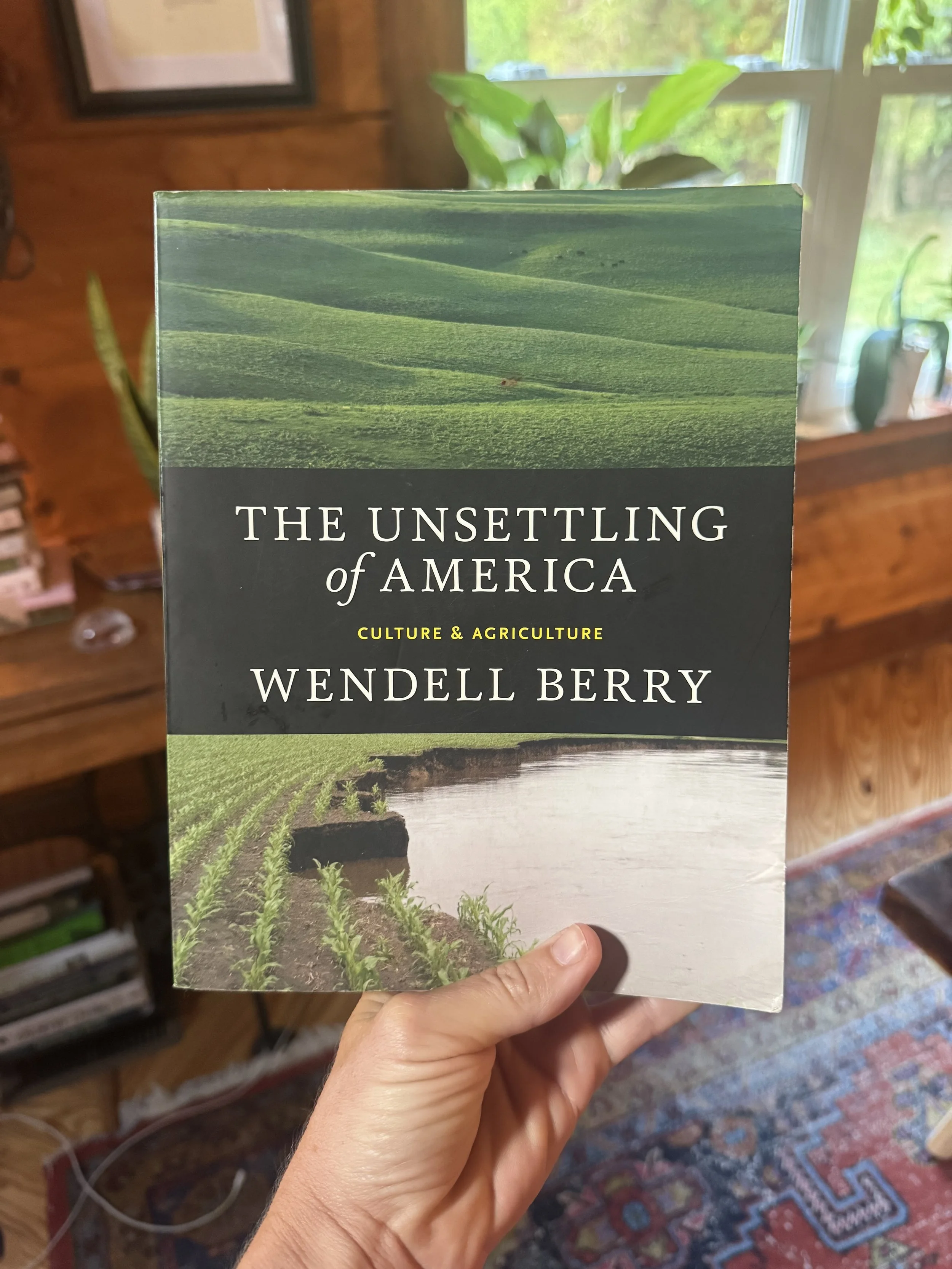
It later came to me through his prose. Becky’s gift of The Unsettling of America became probably the most devastating book I’ve ever read.
It didn’t matter what he wrote, he was always asking the hardest goddam questions. What does this choice require me not to see? What relationship does this convenience sever? What is being called progress here, and by whom? Who or what has been made invisible so that this thing may appear efficient? What do I owe this place because I belong to it?
Questions the modern world has spent immense energy teaching us not to ask. We are encouraged instead to ask whether the economy is growing, whether the technology is faster, whether the farm is productive, whether the company is profitable. Berry kept returning to the prior question: toward what end?
His great subject, across essays and poems and fiction and public argument, was the catastrophe of disconnection. Modern life, in his telling, is distinguished by its extraordinary talent for separating things that remain healthy only in relationship: work from consequence, consumption from production, food from soil, knowledge from affection, the economy from the earth, the health of the individual from the health of the community, the apparent success of one generation from the costs imposed upon the next. We have become brilliant at managing fragments and remarkably poor at perceiving wholes.
Berry spent a lifetime insisting that the whole was the point. His subject was membership: the obligations created by belonging to a household, a community, a watershed, a landscape, a generation. Farming gave him a language through which to examine these relationships because a farm offers nowhere to hide from consequence for very long. Exhaust the soil and something eventually fails. Remove every hedgerow, simplify every field, eliminate every redundancy in the name of production, and the costs just return in a different form. But Berry was never writing only about farms. He was writing about civilization, and about what happens when a civilization forgets that it is a biological and moral enterprise before it is an economic one.
He was also, I think, writing about love.
To love a place is not merely to find it beautiful. It is to accept some obligation for what becomes of it. To love a person is to resist reducing that person to a role, a function, a cost, a market segment, a unit of productivity. To love the future is to leave something intact for people whose names we will never know. To love the world is to recognize that our appetite does not constitute an unlimited claim upon it.
This understanding has shaped almost everything we are trying to build.
The Tomorrow Company did not arise as an attempt to translate Berry into some kind of organizational theory, but his philosophy is nonetheless the foundation of our work. We have come to believe that organizations, like farms and forests and communities, are living systems before they are machines; that health is a more useful aspiration than perpetual growth; that resilience requires relationship and diversity and limits; that the relentless pursuit of efficiency often destroys precisely the capacities a system later discovers it needs. We have tried to ask of companies a version of Berry’s old question: not merely whether they are performing, but whether the life inside them is becoming better or worse.
This has led us again and again toward the same conclusion he reached through the soil: that what appears soft is often structural. Trust. Belonging. Memory. Story. Local knowledge. Human judgment. Modern management has an unfortunate tendency to regard such things as nice when affordable but expendable under pressure. Berry understood that ecosystems work almost exactly the opposite way. The relationships are the infrastructure.
Eventually, perhaps inevitably, these ideas led us out of conference rooms and onto land. The Ranch has become the most literal expression of Berry’s influence on my life. We are planting trees whose mature shade we are unlikely to enjoy. We are learning the names of plants we once passed without seeing. We are watching where water rests and where the soil stays wet and where the summer heat turns clay into concrete that will bend a t-post like willow branch. We are trying to understand what a pasture wants to become before imposing what we want it to be. We are learning that stewardship is a practice, and usually a humbling one.
Berry gave me a sequence for this, though I do not know that he ever stated it exactly this way: ignorance honestly acknowledged can become attention; attention sustained can become affection; affection accepted can become responsibility; and responsibility practiced over time can become good work.
That may be as close as I have come to a personal philosophy.
One of the things I admired most about Berry was that he refused to make hope sentimental. He did not confuse optimism with virtue. He spent his lifetime watching many of the forces he opposed grow vastly more powerful: industrial agriculture, extractive economics, technological dependence, the hollowing-out of rural communities, the substitution of distant systems for local competence. He could see destruction clearly, and he did not pretend that naming it guaranteed its reversal.
And still he planted and farmed and wrote and remained. He ended just as we’re beginning. Our little memorial to Wendell Berry, then, will not be simply that we agree with him. Agreement is cheap. The better memorial is practice.
We’ll repair things we could replace. We’ll something from someone whose name we know. We’ll learn where our water comes from. We’ll plant something that will outlive us. We’ll stick around through a difficulty we want to run from. We’ll keep in relationship even when it gets frustrating. We’ll refuse the cheap thing when we know the true cost is simply being paid somewhere else, by somebody else, who probably is less at choice than we are. We’ll make companies more humane. We’ll make a patch of earth more alive. We’ll try to be useful to our neighbors. We’ll pay attention.
The teacher is gone. The work remains. It’s up to us now.
‘
Every story here is written by us. No AI involved.
